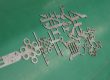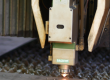
Fiber laser technology has become a major technology revolution in recent years , let’s find out together what fiber laser technology can do in real life.
Laser marking technology is one of the larger utilization branches of laser production. Laser marking is a type of marking method in which high-energy-density laser is used to illuminate the part of the workpiece, so that the surface material is vaporized or chemical feedback of color changes is generated, leaving a permanent mark. Laser marking can produce a variety of pens, inks, symbols and graphics, and the character size can be on the order of millimeters to micrometers, which is of extraordinary significance to the anti-counterfeiting of the product. The focused ultra-fine laser beam is like a knife, which can remove the material of the object’s appearance point by point. Its predecessor is that the marking process is non-contact production, no machine squeeze or machine stress occurs, so it will not damage the produced items; The laser focused size is small, the heat-affected area is small, and the production is precise. Therefore, many conventional methods can be achieved.
The “tool” used in laser production is the focused light spot. It does not need to be rated to reduce other facilities and materials. Only the laser can work abnormally, and it can interrupt production forever. Laser production is fast and expensive. Laser production is actively controlled by a computer, and there is no need for compensation intervention during processing.
What kind of data the laser can mark is only related to the content produced in the computer. Only the marking system of the artwork produced in the computer can be identified, so the marking machine can accurately restore the production data on a suitable carrier. So the performance of the software really determines the performance of the system on a large level.
Laser cutting technology
Laser cutting machine
Laser cutting technology is widely used in the production of metal and non-metal materials, which can greatly reduce the production time, reduce the production cost, and improve the quality of the workpiece. The ancient laser became the “sword” of “iron shaving like iron” that people dream of. Taking our company’s CO2 laser cutting machine as an example, the entire system consists of a control system, a static system, an optical system, a water-cooling system, a smoke exhaust and a care system, etc., adopting the earliest numerically controlled form to complete multi-axis linkage and laser speed The impact of iso-energy cutting, at the same time, against DXP, PLT, CNC and other graphical patterns and strengthen the interface graphics drawing resolution characteristics; adopting a well-functioning entrance servo electromechanical and transmission-oriented structure to achieve superior static accuracy in high-speed form.
Laser cutting is accomplished using the high power density energy that occurs after laser focusing. Under the control of a computer, the laser is discharged through a pulse, so that a controlled repetitive high-frequency pulse laser is input, resulting in a beam with a positive frequency and a certain pulse width. The pulsed laser beam is transmitted and reflected through the optical path and focused by the focusing lens group. On the appearance of the production object, a small, high-energy-density light spot is created, and the focal spot is located near the surface to be produced, and the material being produced is melted or vaporized at a low temperature. Every high-energy laser pulse immediately sputters a large hole on the surface of the object. Under the control of a computer, the laser production head and the material being produced stop drawing intermittently and statically according to the graphics drawn afterwards, so that the object will be produced. Into the desired form. During cutting, a coaxial airflow is emitted from the cutting head, and the melted or vaporized material is blown out from the bottom of the lingo (Note: if the blown gas and the material being cut are thermally fed back, this feedback will bring Additional power required for cutting; the airflow additionally cools the cut surface, reducing the heat-affected zone and protecting the focusing lens from purification.) Compared with the traditional method of sheet metal production, laser cutting has high cutting quality (narrow cryptic width, small heat affected zone, bright cryptic), high cutting speed, high flexibility (can be cut in any shape), and a large number of materials conform to Sex and other advantages.
Laser welding is one of the main aspects of the use of laser material production technology. The welding process is thermally conductive, that is, the radiation of the workpiece is heated by laser radiation. The external heat is dissipated to the outside through thermal conduction, and the laser pulse width, energy, peak power, and repetition frequency are controlled. Parameters that cause the workpiece to melt and cause a specific melt pool. Because of its peculiar advantages, it has been successfully used in welding of micro and small parts. The emergence of high-power CO2 and high-power YAG lasers has opened up new branches of laser welding. Deep welding based on the theory of pinhole effect has been achieved, and it has been increasingly used in industrial parts such as machinery, automobiles, and steel.
Compared with other welding techniques, the important advantages of laser welding are: fast laser welding speed, large depth, and small deformation. Can stop welding at room temperature or extraordinary conditions, the installation of welding facilities is simple. For example, the laser beam will not shift when it passes through the electromagnetic field; the laser can be welded in the case of air and a certain gas, and can stop welding by passing through glass or a material with a clear beam. After the laser is focused, the power density is high. When welding high-power devices, the aspect ratio can reach 5: 1 and the highest can reach 10: 1. Can weld refractory materials such as titanium, quartz, etc., and can weld the same-sex materials, the effect is superior. For example, welding two materials that are fundamentally different from copper and tantalum, the pass rate is almost 100%. Micro-welding can also be stopped. After focusing, the laser beam can obtain a small spot, and it can be finely positioned. It can be used in the assembly welding of a small number of actively processed micro and small components. With laser welding, not only the processing efficiency is large and high, but also the heat affected area is small, and the welding points are not purified, which greatly improves the welding quality.
It can weld the hard-to-reach areas, and performs non-contact long-distance welding, which has great flexibility. The adoption of optical fiber transmission technology in YAG laser technology has made laser welding technology more widely implemented and utilized. The laser beam is easy to complete the fixed time and space beam splitting. It can stop the simultaneous production of multiple beams and the production of multiple stations, which brings a prerequisite for more precise welding.